The boos and disapproving shouts began quickly.
At the University of Central Florida’s 2026 commencement ceremony, graduates were expecting a celebratory speech about the future. Then the speaker, real estate executive Gloria Caulfield, began discussing artificial intelligence, calling it the next industrial revolution. The mood changed immediately. Students expressed their displeasure so loudly that she paused and asked what had happened.
What happened can be read as recognition of a new reality, rather than confusion.
For young people entering the labour market, AI is no longer an abstract idea about the future or simply a study tool. It already screens résumés, helps with or takes over tasks, and produces text and images. Employers increasingly treat familiarity with it as a basic skill. At the same time, AI can perform some of the entry-level tasks through which junior employees used to gain experience.
Here is Gen Z’s central paradox: many use AI, sometimes intensively, while becoming less comfortable with the social arrangements developing around it. Their resistance need not mean rejecting technology. It can mean refusing a system in which benefits appear to flow upwards while risks — insecure work, cognitive dependence, the appropriation of creative work, surveillance and weakened authenticity — fall heavily on them.
The question is not simply whether AI should exist. It is who controls it, who profits, whose work trained it, whose prospects it narrows and whether people retain authorship over what gives culture, work and education their meaning.
A generation that uses AI without necessarily trusting it
On paper, Gen Z looks like the ideal AI generation. It grew up with smartphones, algorithmic feeds, the creator economy and instant search. Its members know how to pick up a tool quickly, test it, modify it and put it to use.
But their relationship with generative AI is not simply excitement. For some, using it can feel like compulsory participation.
A 2026 survey by Gallup, the Walton Family Foundation and GSV Ventures found that 51% of Americans aged 14–29 used generative AI at least weekly: 22% daily and 29% weekly. Enthusiasm was declining: 22% reported excitement and 18% hopefulness, while 31% reported anger and 42% anxiety. Curiosity, at 49%, was the most common emotion. Curiosity, however, is not the same as trust.
There is no necessary hypocrisy here. People may use a system they distrust when it becomes important for education, employment and career competition. AI can help summarise notes, draft a letter, debug code or prepare for an interview, while also prompting fears that the value of their labour is being eroded.
Among employed Gen Z respondents, 69% placed greater trust in work completed without AI, compared with 28% for AI-assisted work and 3% for work produced solely by AI. These findings challenge the assumption that growing up with digital technology automatically produces trust in digital systems.
The first generation entering work alongside generative AI
Every generation enters working life with its own technological history. Many millennials entered the labour market after the financial crisis and had to become more flexible about careers and employment. Gen Z is entering the era of generative AI, facing pressure to be adaptable, fluent in prompting and entrepreneurial, while worrying about being replaceable.
The fall 2025 Harvard Youth Poll found that 59% of Americans aged 18–29 regarded AI as a threat to their job prospects. Forty-four per cent expected it to take opportunities away, while 14% thought it would create them. Forty-one per cent expected it to make work less meaningful. These figures measure young people’s expectations, not actual job losses caused by AI.
The concern extends beyond losing jobs. A deeper risk is the disappearance of the first layer of work: the simple tasks through which professional judgement develops. Writing a first draft, preparing research notes, cleaning data, producing basic copy, editing an image and testing code often form an invisible school for junior professionals.
Recruitment adds another layer. Before AI replaces them, many young applicants feel they must first get past it. Algorithmic screening, automated video interviews, résumé parsers and AI-supported recruitment can make a job search feel like negotiating with a black box. Applicants may find themselves writing for machines as much as for recruiters.
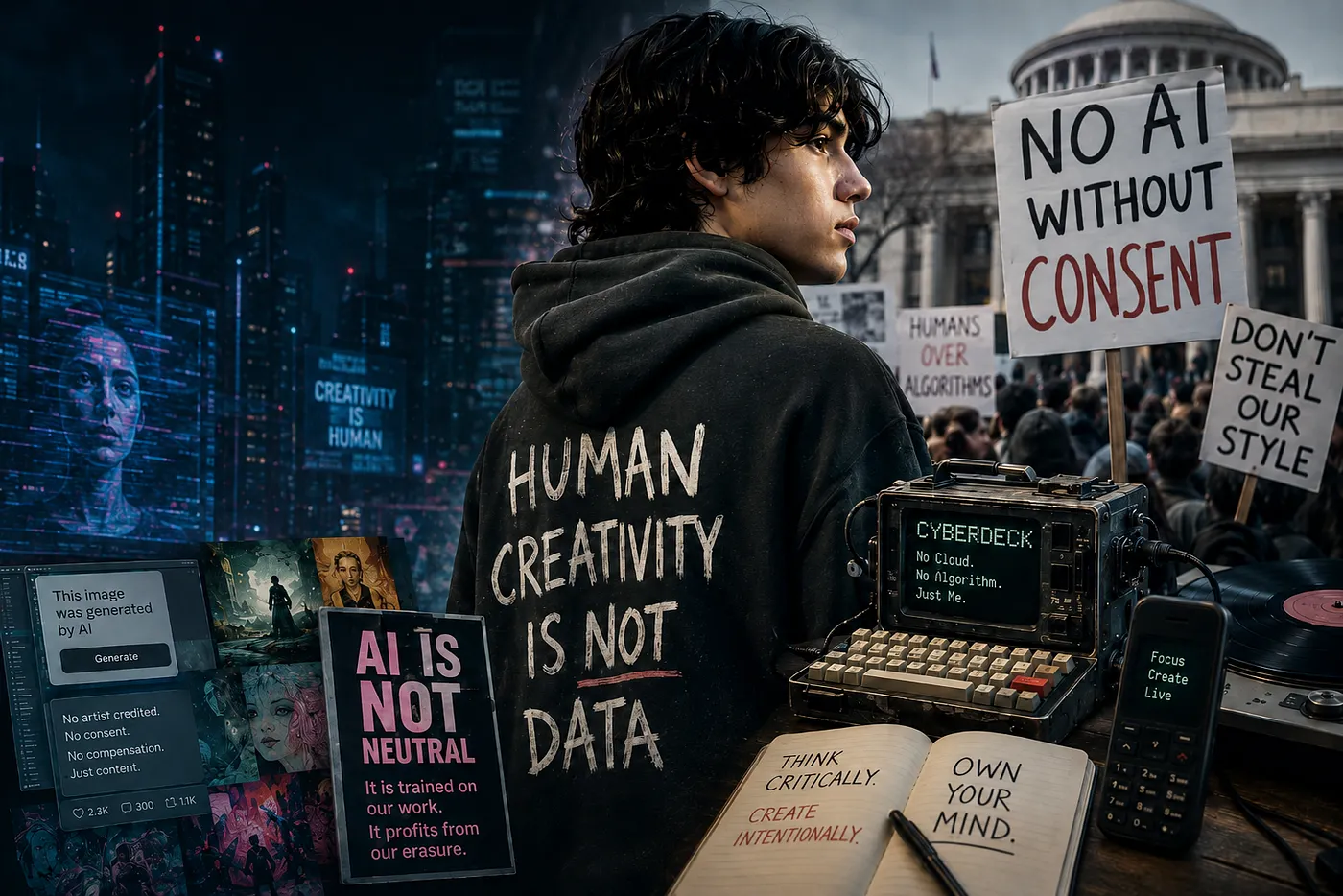
‘Don’t steal our style’: the creative backlash
Some of the strongest reactions against generative AI have emerged in culture, where the automation of creative labour is particularly visible.
For young artists, designers, musicians, animators, writers and game makers, AI is more than a productivity tool. A central concern is that models may be trained on human work without consent, payment or credit. Their outputs arrive quickly, smoothly and cheaply, intensifying that objection.
Creative criticism has several layers. Economically, AI may displace paid entry-level work. Ethically, creators question how training material was obtained. Aesthetically, some audiences recognise a polished emptiness in generic AI images. More fundamentally, art is not just an output: it carries traces of human experience, taste, mistakes, effort and intention.
That helps explain the backlash. San Diego Comic-Con changed its art-show rules following objections to AI-generated images. Bandcamp announced that music generated wholly or substantially by AI would not be permitted. Both disputes draw attention to the boundary between assistance and replacement.
The appeal of going offline
Resistance to AI also appears in everyday choices: flip phones, paper notebooks, vinyl records, point-and-shoot cameras, basic mobile phones, offline writing devices and computers assembled by hand.
Digital minimalism is not new. For some young people, going offline may be less an exercise in nostalgia than a way to establish a psychological boundary. The cyberdeck is a useful symbol: a DIY computer, often assembled from a Raspberry Pi, a mechanical keyboard, an old case and whatever parts its maker can find. Its value lies in control rather than raw power. It expresses a wish for a machine that can be understood, changed, broken and repaired.
The fear of outsourcing thought
If employment anxiety concerns the future of work, cognitive anxiety concerns the future of the self.
For students, AI can be both a temptation and a risk. It can explain a concept, summarise an article, outline an essay, create flashcards or solve a problem. Used carefully, it can function as a tutor. Used passively, it can become a substitute for thinking.
Eight in ten Gen Z respondents in Gallup’s survey thought using AI tools was very or somewhat likely to make learning more difficult for them in the future. That is a measure of concern, not proof of cognitive harm. It nevertheless suggests awareness of a possible trade-off: a faster result now and weaker mastery later.
The distinction is whether students are thinking with AI or allowing it to do the thinking for them.
A demand for a say in the future
One interpretation of Gen Z’s resistance is that it targets exploitation, opacity, replacement, surveillance and inauthenticity more than technology itself. This is an editorial reading of diverse reactions, not a claim that an entire generation shares one position.
Those concerns translate into concrete demands: consent around the systems using AI; protection of human authorship on creative platforms; preservation of the first rungs of a career; and education that teaches AI without allowing it to consume the process of learning.
The boos at the University of Central Florida did not end the speech. They interrupted a familiar script in which AI is presented only as inevitable progress. Read in that light, the response was less a rejection of the future than a demand for a voice in shaping it.