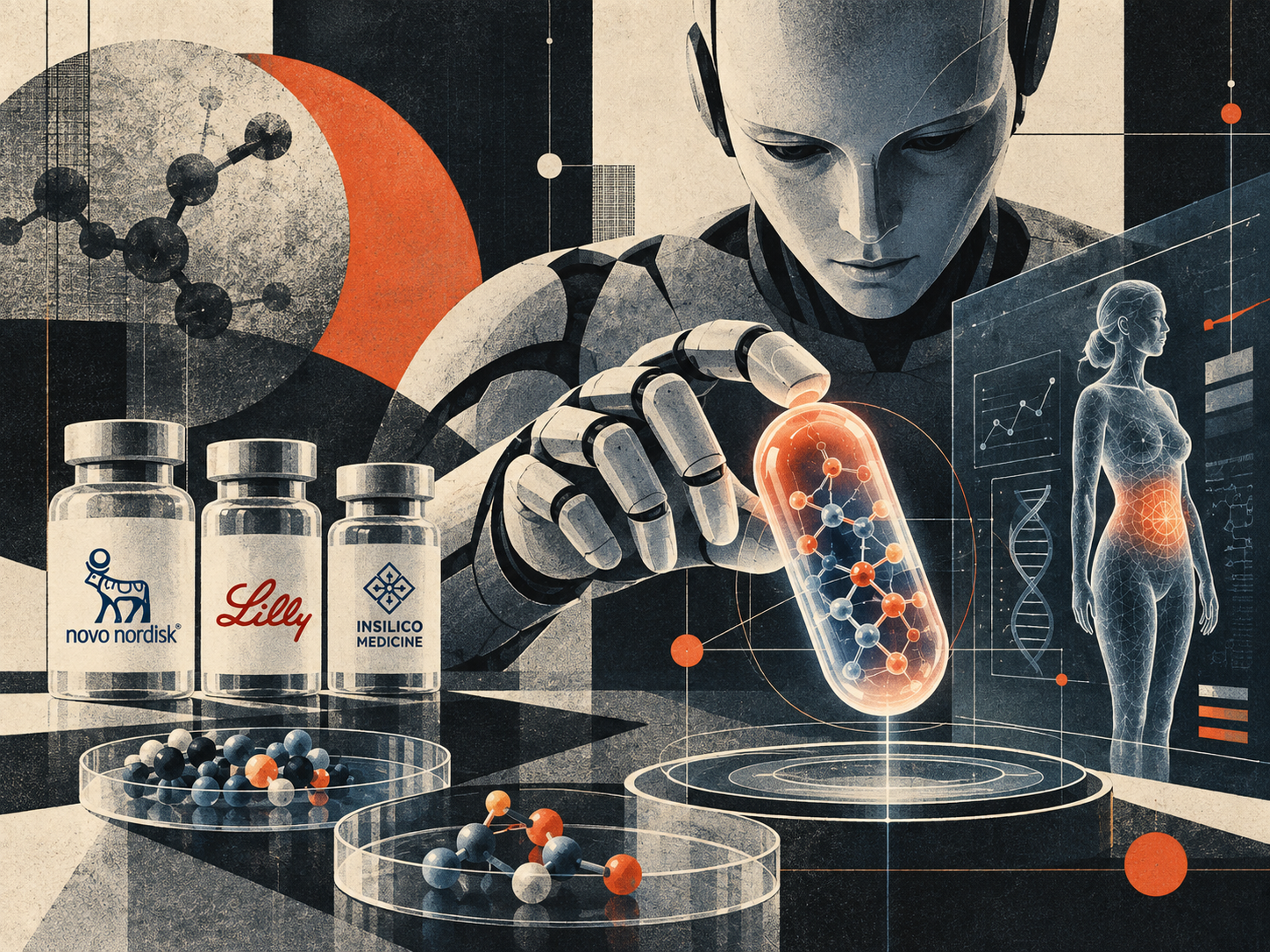
The success of Ozempic and Wegovy has triggered a new race in the pharmaceutical industry: what could come after GLP-1 medicines? Artificial intelligence is already part of that process, but this does not mean AI has created an approved “next Ozempic.”
According to Novo Nordisk’s 2024 annual report, the company uses AI in drug-target identification, molecular design and clinical-trial optimisation. Combined with high-throughput laboratory experiments, the company assessed about one billion virtual molecules computationally and then screened around 2,500 compounds in the lab. Novo says the process helped identify a highly selective amylin compound that closely mimics the natural hormone, while reducing the number of design cycles by 50–75%.
These are results described in a company report. They are not independent clinical evidence that AI has already produced an effective new treatment. A candidate must still pass extensive research and clinical testing before it could become a medicine for patients.
The search goes beyond GLP-1
GLP-1 is only one avenue. Researchers are exploring therapies that combine or act on GLP-1, GIP, glucagon and amylin systems. A 2026 review in Nature Reviews Drug Discovery describes multi-receptor approaches as an important direction in the development of obesity treatments.
That creates an enormous search space: possible targets, chemical structures and combinations. AI can use existing data to narrow the field and help scientists prioritise compounds for testing. Experiments, however, provide the evidence needed to determine whether a candidate works.
AI is also designing candidates
A more direct example of generative AI comes from Insilico Medicine’s cardiometabolic portfolio. In a 2025 announcement, the company described eight oral small molecules involving several biological targets, including GLP-1R, GIPR and amylin. Two GLP-1 receptor agonists had reached the preclinical-candidate stage; the other programmes were at different, earlier stages.
These are programmes presented by the company, not approved medicines or treatments shown to work in people. Their significance is that AI is being used for more than processing scientific text: it is involved in target selection, molecule generation, property prediction and prioritising laboratory tests.
What changed in 2026
In April, Novo Nordisk announced a collaboration with OpenAI. The company said it planned to use AI to analyse complex data, identify promising drug candidates and test scientific hypotheses. In September, Novo announced a collaboration with Anthropic, focused on using Claude for scientific reasoning and specific drug-discovery workflows.
These partnerships describe company plans. By themselves, they do not show that the collaborations have already produced a new drug candidate or a clinical result.
A smaller search space is not a clinical conclusion
Novo Nordisk and Eli Lilly are joined by other pharmaceutical and biotechnology companies competing to develop obesity medicines. Reuters reported in September 2026 that many are pursuing pills, longer-acting injections and therapies that act on multiple targets.
The practical value of AI at this stage is more modest and specific: it can help researchers reduce a vast set of possible molecules to a smaller number worth testing. This may speed up discovery, but it does not replace laboratory validation, clinical trials or independent assessment.
The search for what comes after Ozempic is therefore still a collaboration between people and machines. Researchers define the questions, assess biological mechanisms and validate results; AI helps identify patterns and molecules that may be worth investigating.
Sources
- Novo Nordisk — Annual Report 2024: AI and drug discovery ↗
- Nature Reviews Drug Discovery — Obesity pharmacotherapy in 2026 ↗
- Novo Nordisk — OpenAI partnership, 14 April 2026 ↗
- Novo Nordisk — Anthropic collaboration, 16 September 2026 ↗
- Insilico Medicine — cardiometabolic portfolio, BIO-Europe 2025 ↗
- Reuters — weight-loss drug developers intensify competition, 21 September 2026 ↗