
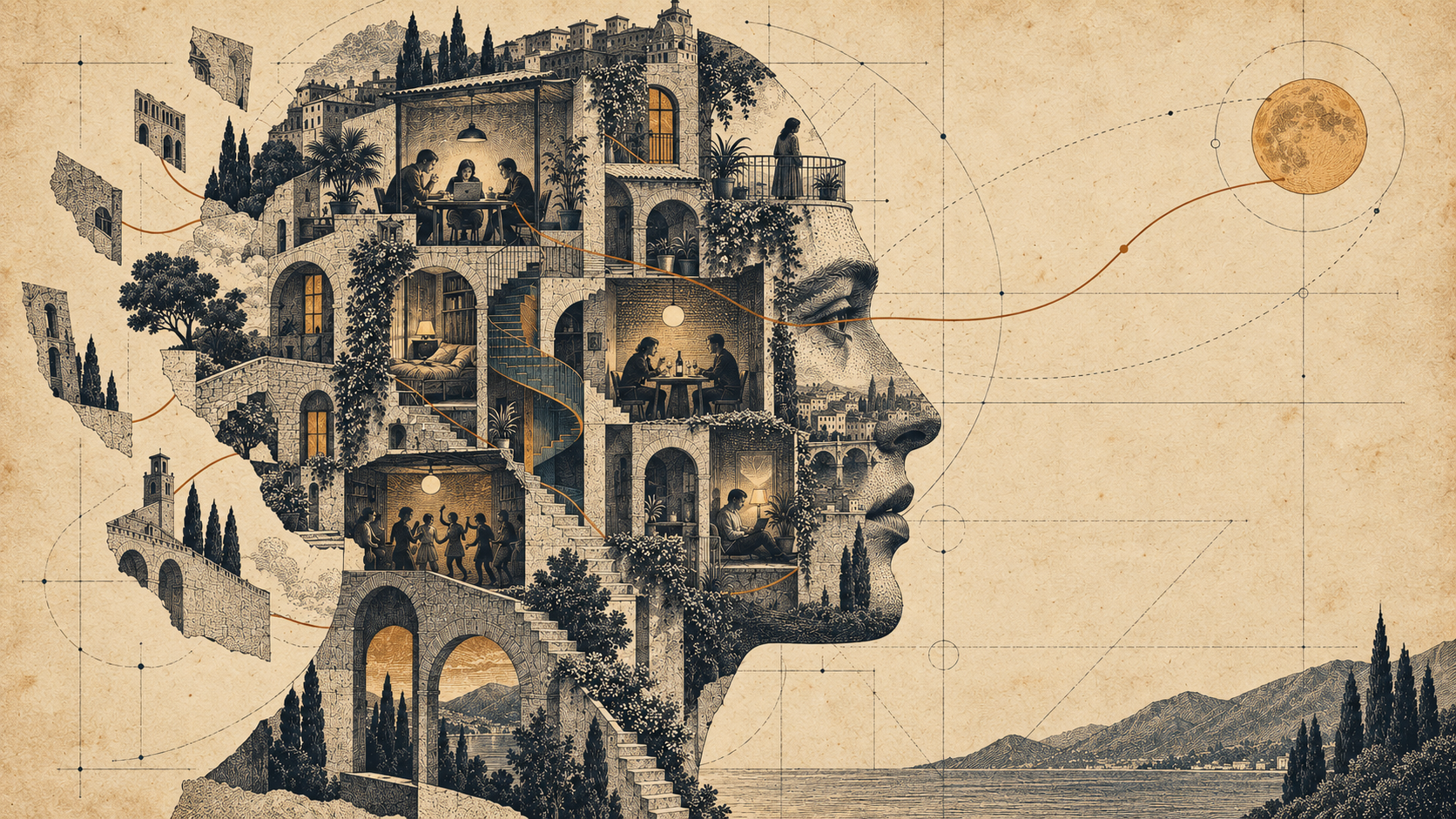
In some circles gathered around artificial intelligence, technology has become a basis for organising everyday life. People work, live, eat and spend their free time together. They share a desire to experiment and a sense that they are directly creating the future. Here, the outlines of a possible new subculture begin to emerge: a professional interest gradually becomes part of friendship, identity and a way of life.
A house that is also a workplace
AI-focused hacker houses offer a clear example. Here, ‘hacker’ means someone who experiments with technology. AGI House brings developers, researchers and digital artists into its community. The value of such an environment goes beyond access to computers: people can share an idea, ask for help and start a new collaboration.
The Residency gives shared living a more structured form. The programme offers participants accommodation, a shared workspace and support so they can concentrate on their ventures. This is not a model designed exclusively for AI, but it illustrates a principle found in technology circles: proximity to like-minded people becomes a resource for developing a project.
From a workshop to a late-night party
In Berlin, Build & Rave connects hands-on learning about AI with nightlife. According to its organisers, a day of learning continues into an evening of socialising and partying. This is a specific event format, not evidence that Berlin’s entire club scene has become an AI movement. It does, however, show how the social space surrounding a technology community can expand.
The sequence itself is revealing: first you make something together, then you relax with the same people. Acquaintances grow out of shared experience. An idea may emerge over dinner, a collaboration may begin at a workshop, and a friendship may continue over music. Gathering around technology no longer fits into one part of the day; it becomes woven into everyday relationships.
A subculture or a professional network?
We cannot call every technology gathering a subculture. Using the same tool is not enough. A shared language, recurring rituals, meeting places and a sense of belonging matter too. These examples contain some of those features, but it is too early to speak of a single, established global movement. Differences remain among the participants themselves.
A startup founder may be looking for investment, a researcher for a solution to a difficult problem, and an artist for a new means of expression. Their interests sometimes align and sometimes conflict. Sharing a space does not automatically remove those differences. Explaining AI communities solely through technological optimism or commercial ambition would oversimplify the picture.
When the working day never ends
One way to interpret these developments is as a weakening of the boundary between work and private life. When a colleague is also your housemate and friend, a professional conversation can continue at any time. That helps knowledge circulate quickly, but it can also make it harder to maintain the distance needed for rest. The same environment can offer both opportunity and pressure.
Alongside belonging comes a question: how freely can someone step out of the collective pace? If everyone around you is constantly building a product, learning a new model or looking for a partner, taking time off may begin to feel like falling behind. This is not a documented experience of every group discussed here; it is an important question raised by the way they are organised.
Access deserves attention too. A shared house or event may make collaboration easier, but participation still requires time, resources and a route into the relevant environment. The visibility of these circles should not be confused with universal accessibility. We need to ask whose experiences appear in these stories and who remains outside them.
The significance of a possible AI subculture lies in these everyday changes. Technology influences whom we meet, how we learn and where we spend our time. Counting the capabilities of new models alone will not explain its cultural effects. We must also observe relationships: how much freedom, collaboration and room for difference these environments allow.